
By Cindy Bohlen, CFA, Director of Responsible Investing and Chief Mindfulness Officer
We often get asked, as responsible investors, what Riverwater’s position is regarding artificial intelligence. Is it good or bad for people and the planet? Should a responsible portfolio own it, or avoid it?
The short answer is that we do not have an official position about whether it is good or bad. The fact is that AI is here, and it is already impacting the world. What matters is whether our portfolio companies are deploying it responsibly.
That question became the foundation of what we now call the Riverwater AI Responsible Investing Paradox Framework, which I introduced during our Q3 2026 quarterly webinar. I would like to share it more fully here, along with how it is shaping our work with the companies in our portfolios.
Why AI Is a Paradox for Responsible Investors
We named this exercise the AI Paradox because, for some, it may seem to be a paradox to say that investing in anything related to AI is responsible. There is a lot of worry, and for good reason, about what the proliferation of AI may mean for the planet and people. Electricity demand is outpacing supply in places, water resources are under pressure, and workers are uneasy about what the technology means for their livelihoods. Cybersecurity risk touches individuals, companies, and physical infrastructure alike.
Yet AI has already demonstrated the potential to bring significant positive change to society, and we think there will likely be more. Companies deploying it are seeing gains in worker productivity and safety. Researchers are using it to speed drug discovery and to make energy systems more efficient.
Both of these things are true, and both matter. As responsible investors, our duty is to invest our clients’ assets in a manner that captures the opportunity of AI while mitigating its risks. Holding those two commitments together is what we mean by the paradox.
A TCFD-Style Framework for AI Risks and Opportunities
To hold both sides with discipline, we built the framework on a structure many investors will recognize. Its organization mirrors the climate scenario analysis developed by the Task Force on Climate-related Financial Disclosures (TCFD), which many investors already use to think through climate risk.
We are contemplating three time horizons: today, the short term, and the intermediate to long term. Within each horizon, we look at the impact on people, on the planet, and on the economic construct, meaning the social and economic systems we all depend on. Across those, we consider two families of risks and opportunities:
- Physical risks and opportunities, both acute and chronic.
- Transition risks and opportunities, which include technological, reputational, and regulatory considerations.
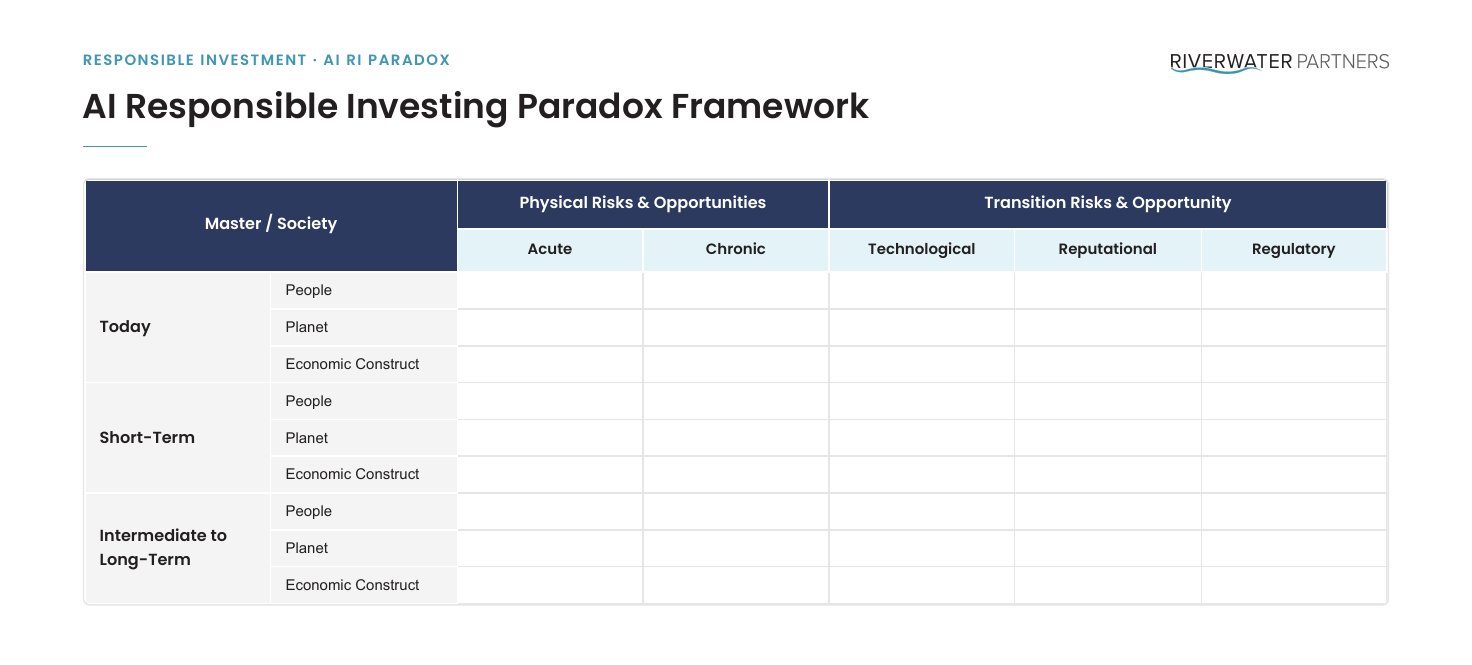
Source: Riverwater Partners, Q3 2026
We have applied this analysis to each sector. We then built a master view that looks across all sectors to reveal the risks and opportunities that appear most often.
AI Risks and Opportunities Across Sectors
Looking across all sectors, a few themes rise to the top. Cybersecurity is a risk in every time horizon and in nearly every sector, touching personal information, corporate systems, and physical infrastructure. Climate and water risks are being felt today, and may become worse if not addressed. And ultimately, social inequality and failing economic constructs could come into play.
On the other hand, there are opportunities. Increased worker productivity and safety are already being seen in companies deploying AI. We are seeing emerging solutions to some of the world’s larger problems, including faster drug discovery and greater energy efficiency. And over the long term, if we get this right, AI could contribute to stronger social and economic constructs.
| Time horizon | Risks | Opportunities |
|---|---|---|
| Today | Cybersecurity threat to individuals; electricity demand exceeding supply; climate and water risk; worker unease | Resource optimization with sensor technology; smart farming to feed a growing population; worker productivity and higher-level work; energy reduction and safety in transportation |
| Short term | Cybersecurity threat to infrastructure; energy shortage; severe environmental degradation; employment mismatch | Electric grid adds clean energy faster; robots replace dangerous physical labor; faster drug discovery to cure disease; productivity enhances economic output |
| Long term | Uncontrollable digital systems; environmental degradation; social and economic inequality; social and economic construct failure | Solutions to the world’s greatest social challenges; environmental healing; lower geopolitical conflict; stronger socio-economic constructs |
AI and Utilities: Data Centers, the Grid, and Risk
We began our sector work with utilities because they have the potential to be both very impacted by AI and very impactful in how it unfolds. Data centers need reliable power, and utilities sit at the place where that need meets the grid, the environment, and the communities they serve.
On the risk side, utilities are already contending with cybersecurity threats, pressure on grid reliability, environmental strain, and regulatory and reputational friction. You only have to open any newspaper to see this happening. If these pressures are not addressed today, they could lead to energy insufficiency, further environmental degradation, and more fragile social and economic systems over the longer term.
On the opportunity side, many utilities are experiencing a positive inflection in revenue growth from new data center customers. Innovation is contributing to more reliable and cleaner energy, and in some cases more affordable energy for all. Over time, that could support grid resilience, natural resource resilience, and stronger social and economic outcomes.
How this all ends is largely a matter of whether AI is deployed responsibly. We believe investors have a meaningful role to play in that outcome.
Applying the Framework Through Active Ownership
The AI Paradox Framework will inform each of the three pillars of Riverwater’s Responsible Investing process: due diligence, engagement, and collaboration.
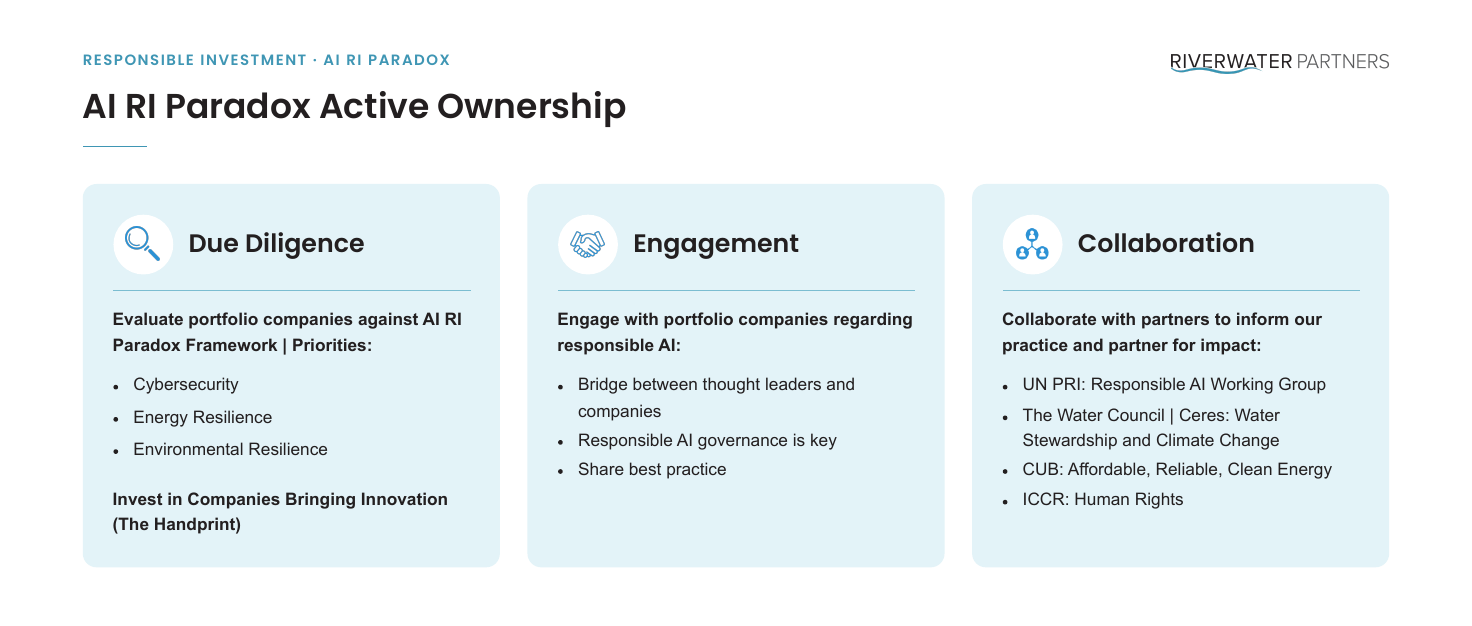
Source: Riverwater Partners, Q3 2026
Due diligence
Our due diligence seeks to understand how each portfolio company is facing AI. Are they protecting against risks to themselves and to society more broadly? What is their footprint? We evaluate companies against the framework with three priorities in mind: cybersecurity, energy resilience, and environmental resilience. We also look to invest in companies bringing innovation to the challenges the framework identifies. Are they innovating to unlock value relating to AI? What handprint opportunities might they create?
We try to hold ourselves to the same standard we ask of the companies we own. At Riverwater, we have embraced AI for internal efficiency. It enables our small crew to do more as our assets under management grow, and it allows the people on our team to give their attention to more thought-provoking questions. We have also developed policy and practice aimed at protecting our clients’ information, their assets, and our commitment to society. Throughout our ten-year history, we have evolved our practice to meet a changing world, and that is what we expect of our portfolio companies.
Engagement
Our active engagement practice will focus on understanding portfolio companies’ attention to these material AI risks and opportunities, and on sharing our ideas to avoid and capture them, respectively. We see our role as a bridge between responsible investing thought leaders and the companies we own. Responsible AI governance is central to these conversations, and we look to share best practice wherever we find it.
Collaboration
We do not do this work alone. We work with our responsible investing thought leader partners to inform our understanding of AI’s impact and to help us understand best practice solutions we can take to our portfolio companies.
- The UN PRI is forming a Responsible AI working group. On a recent call, it was encouraging to hear that many of its evolving conclusions are similar to the ones we have reached.
- The Water Council and Ceres inform our thinking on water stewardship and climate change.
- The Citizens Utility Board helps us understand best practice for affordable, reliable, and clean energy.
- ICCR helps us understand how to approach AI through the lens of human rights.
Responsible AI Investing: An Invitation
We recognize that AI and responsible investing may seem paradoxical to some today. It is all very new, and our understanding will keep evolving, as it should. We are trying to get ahead of that curve and understand how AI will impact society and the planet, our portfolio companies, and therefore our clients’ portfolios.
This framework is designed to help us dig deep during due diligence and to use our seat at the table during engagement to bring our informed ideas to the companies we own. Ultimately, our goal is to deliver superior, responsibly generated risk-adjusted returns for our clients in this evolving age of AI.
If you are wrestling with these same questions, whether as a client, a fellow investor, or a company leader, I extend an invitation to continue the conversation with us. None of us will resolve this paradox alone, and it is worth our time to work through it together.
The information provided herein reflects the opinions of Riverwater Partners, LLC as of the date of publication and is subject to change without notice. It is provided for informational and educational purposes only and should not be construed as investment advice or a recommendation to buy or sell any security. Past performance is not indicative of future results. Investing involves risk, including the potential loss of principal. Riverwater Partners does not guarantee the accuracy or completeness of this information and is not responsible for any errors or omissions. Clients or prospective clients should consult their financial advisor before making any investment decisions. Riverwater Partners is a Registered Investment Advisor with the U.S. Securities and Exchange Commission (SEC).