
Active Stewardship – Engagement that Creates Value for Mindful Investors
As contrarian investors, we’ve learned that the most meaningful conversations often happen away from the quarterly earnings spotlight. While markets focus on short-term metrics, we engage with management teams on the fundamental questions that drive long-term value creation—questions that align with our Three Pillar Approach® and our commitment to responsible investing.
After more than nine years of building relationships with small-cap management teams, we’ve discovered that constructive engagement isn’t about confrontation or activism. It’s about partnership, shared learning, and creating value that extends far beyond the balance sheet.
The Foundation: Why Engagement Matters
Before diving into specific examples, it’s worth understanding why engagement sits at the heart of our investment philosophy. When you’re investing in concentrated portfolios of 25-45 companies—rather than the 100+ holdings common in many funds—each relationship matters profoundly.
Our research-driven approach means we don’t just analyze numbers; we analyze the people behind those numbers. We want to understand not just what management teams are doing, but why they’re doing it and how their decisions align with long-term stakeholder value.
This is where our responsible investing mandate becomes a competitive advantage. While other managers might focus solely on financial metrics, we engage on environmental, social, and governance factors that increasingly drive business performance.
Real-World Engagement: Three Case Studies
Case Study 1: The Supply Chain Transformation
The Situation: One of our portfolio companies, a small-cap manufacturer, was facing rising raw material costs and increasing customer demands for supply chain transparency.
Our Approach: Rather than simply asking about cost mitigation strategies during a quarterly call, we initiated a deeper conversation about supply chain resilience and sustainability. We arranged a facility visit and brought specific research on industry best practices.
The Dialogue:
We shared research on how companies in adjacent industries had successfully implemented circular economy principles. We discussed the long-term competitive advantages of supply chain diversification and explored how transparency initiatives could become a differentiating factor with customers.
The Outcome: Management implemented a comprehensive supplier diversity program and began tracking Scope 3 emissions. Within 18 months, the company had reduced costs by 12% and secured two major contracts specifically because of their enhanced supply chain transparency.
Key Learning: Sometimes the most valuable engagement happens when you bring solutions, not just questions.
Case Study 2: The Governance Evolution
The Situation: A family-founded technology company in our portfolio was transitioning from first-generation to second-generation leadership, creating both opportunities and governance challenges.
Our Approach: We leveraged our own experience as a family business to facilitate productive conversations about succession planning and board independence.
The Dialogue:
We shared insights from our research on successful family business transitions. We discussed the balance between maintaining entrepreneurial culture and implementing institutional governance and explored board composition that would preserve family values while adding independent expertise.
The Outcome: The company added three independent directors with complementary expertise, implemented formal succession planning, and established clear governance protocols. The stock has outperformed its peer group by 23% since these changes were implemented.
Key Learning: Personal experience and empathy often unlock conversations that pure financial analysis cannot.
Case Study 3: The ESG Integration Challenge
The Situation: A small-cap energy services company was struggling to articulate its environmental value proposition to customers increasingly focused on sustainability.
Our Approach: We facilitated connections between management and industry sustainability experts, and helped frame their existing practices within the broader ESG narrative.
The Dialogue:
We organized a roundtable with other portfolio companies facing similar challenges. We shared research on how investors and customers were evaluating ESG performance in their sector and discussed measurement and reporting frameworks that could highlight their existing strengths.
The Outcome: The company developed a comprehensive sustainability strategy, improved their ESG disclosure, and reported winning additional contracts partly attributed to their enhanced environmental profile. Management noted improved customer retention metrics as well.1
Key Learning: Sometimes companies are doing good work but need help telling their story effectively.
Best Practices for Productive Dialogue
Through these and dozens of other engagements, we’ve developed a framework for productive management dialogue:
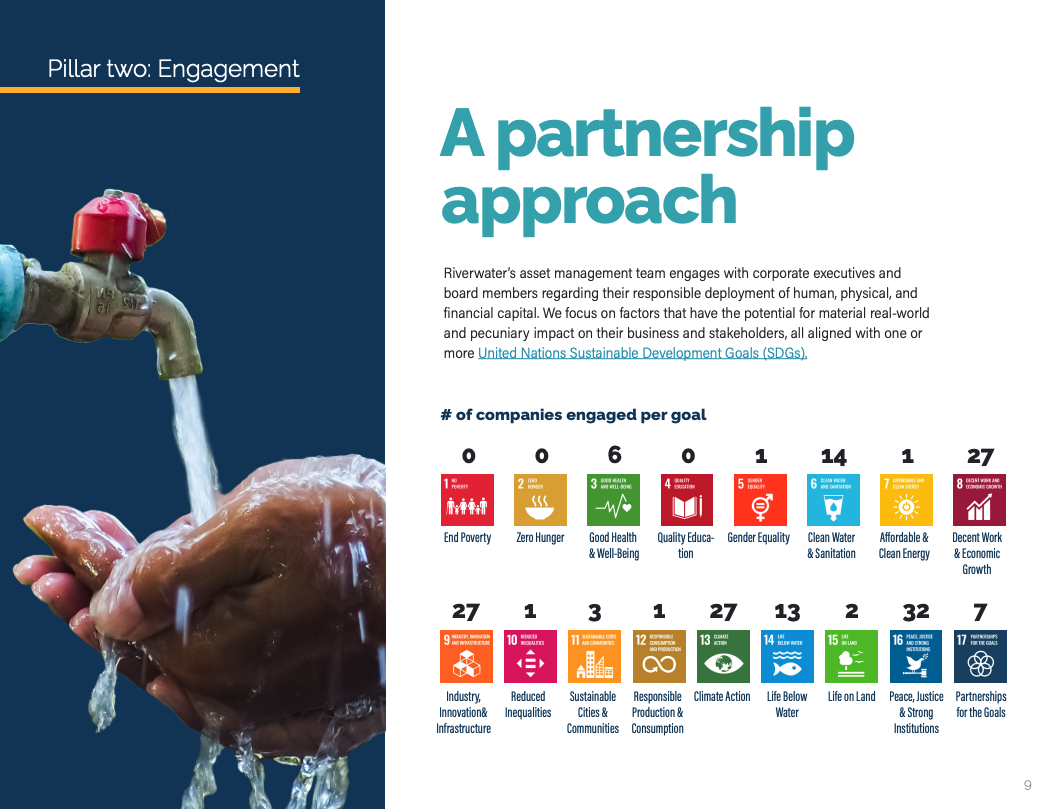
2024 Riverwater Sustainability Report Engagement Graphic
1. Come Prepared with Context
Don’t: Ask generic questions about guidance or strategy
Do: Bring specific industry research, peer comparisons, and actionable insights
We spend significant time preparing for management conversations. This isn’t just about understanding their business—it’s about understanding their challenges within the broader industry and economic context. When we can reference how similar companies have navigated comparable situations, conversations become collaborative rather than interrogative.
2. Focus on Long-Term Value Creation
Don’t: Push for short-term fixes that might compromise long-term positioning
Do: Explore how current decisions will impact competitive positioning over a medium to long-term horizon
Our investment philosophy is built on long-term thinking. When we engage with management, we’re explicitly looking beyond the next quarter or even the next year. This long-term focus often reveals opportunities and challenges that aren’t apparent in traditional financial analysis.
3. Leverage Your Unique Perspective
Don’t: Repeat questions that management hears from every investor
Do: Use your specialized knowledge and values-driven approach to add genuine insight
As Wisconsin’s largest dedicated responsible investment manager, we bring a unique perspective to management conversations. We understand both the challenges and opportunities of implementing sustainable business practices. This expertise allows us to have conversations that other investors simply cannot.
4. Make It Collaborative, Not Confrontational
Don’t: Approach engagement as oversight or criticism
Do: Position yourself as a long-term partner interested in mutual success
The most productive engagements feel like strategy sessions between partners, not interrogations between adversaries. We’re explicit about our long-term investment horizon and our interest in supporting management teams in building stronger, more sustainable businesses.
5. Follow Up and Follow Through
Don’t: Let good conversations die in boardroom notes
Do: Maintain ongoing dialogue and provide resources when helpful
Engagement doesn’t end when the meeting does. We maintain regular touchpoints with management teams, share relevant research as we encounter it, and make introductions when we think they might be helpful. These ongoing relationships often yield the most significant insights and value creation opportunities.
The Measurement Challenge
One question we frequently encounter is how to measure the impact of engagement. While it’s difficult to draw direct causal lines between conversations and stock performance, we track several indicators:
Quantitative Metrics:
Portfolio company ESG scores and ratings improvements, implementation of governance best practices, and measurable business improvements in areas we’ve discussed.
Qualitative Indicators:
Frequency and depth of management communication, management receptiveness to new ideas and perspectives, and evidence of implemented suggestions in subsequent quarters.
Most importantly, we evaluate engagement success through the lens of our Three Pillar Approach®. Has the engagement improved our understanding of the company’s valuation? Has it strengthened our conviction in management quality? Has it enhanced the company’s responsible business practices?
Looking Forward: The Future of Engagement
As we continue to grow our assets under management, we’re constantly refining our engagement approach. Several trends are shaping how we think about future management dialogue:
Increased Focus on Climate Adaptation: Small-cap companies often lack the resources for comprehensive climate risk assessment. We’re increasingly helping management teams understand and prepare for climate-related business impacts.
Technology-Enabled Stakeholder Engagement: We’re exploring how technology can facilitate more frequent and meaningful dialogue with management teams, particularly as our portfolio grows.
Peer Learning Networks: We’re organizing more opportunities for our portfolio company management teams to learn from each other, particularly on ESG implementation and governance best practices.
Why This Matters for Long-Term Returns
Skeptics sometimes ask whether this level of engagement is worth the time and resources required. Our experience suggests it absolutely is—for several reasons:
Information Advantage: Deep engagement relationships give us insights that aren’t available through traditional research channels. We often understand strategic inflection points months before they become apparent in financial statements.
Risk Mitigation: By engaging on governance and sustainability topics, we help our portfolio companies avoid the risks that increasingly impact business performance. Companies with strong ESG practices consistently show lower volatility and better crisis resilience.
Value Creation: When engagement leads to tangible business improvements—better governance, stronger stakeholder relationships, improved operational efficiency—it directly contributes to investment returns.
Alignment: Perhaps most importantly, this approach aligns with our mission to make the world a better place by growing wealth through responsible investing. We’re not just passive beneficiaries of company performance; we’re active contributors to building stronger, more sustainable businesses.
The Riverwater Difference
What makes our engagement approach different isn’t just our focus on responsible investing—it’s our commitment to genuine partnership. As a boutique, independent firm, we have the flexibility to maintain the deep, ongoing relationships that drive meaningful engagement.
We’re not trying to be everything to everyone. We’re trying to be the ideal long-term partner for management teams who share our commitment to building businesses that create value for all stakeholders—shareholders, employees, customers, communities, and the environment.
This is contrarian thinking applied to investor relations. While others focus on quarterly performance and short-term metrics, we invest time in understanding the fundamental drivers of long-term value creation. While others see ESG as a compliance exercise, we see it as a source of competitive advantage and risk mitigation.
Getting Started: A Framework for Other Investors
For other investors interested in enhancing their management engagement, we recommend starting with these steps:
1. Define Your Value-Add: What unique perspective or expertise can you bring to management conversations?
2. Invest in Preparation: Dedicate significant time to understanding not just the company, but its industry context and peer challenges.
3. Build Genuine Relationships: Approach engagement as partnership, not oversight.
4. Be Patient: Meaningful engagement and its impact on business performance takes time to develop and demonstrate.
5. Stay True to Your Investment Philosophy: Let your fundamental investment approach guide your engagement priorities.
At Riverwater Partners, constructive management engagement is a natural extension of our research-driven, values-aligned investment philosophy. It’s how we fulfill our fiduciary duty to clients while staying true to our mission of making the world a better place through responsible investing.
Interested in learning more about our approach to small-cap value investing? Schedule a discovery call to discuss how our Three Pillar Approach® might align with your investment objectives.
Citations
This commentary reflects the views of Riverwater Partners as of November 2025 and is subject to change without notice. It is provided for informational purposes only and does not constitute investment advice or a recommendation to buy or sell any securities. Case studies and examples are for illustrative purposes only and may not be representative of all client portfolios or typical results. Past performance is not indicative of future results. The engagement outcomes described represent specific instances and do not guarantee similar results in other situations. Investors should consult their financial adviser before making any investment decisions.
Links to third-party sites are provided for convenience and do not imply endorsement. Riverwater is not responsible for the accuracy or content of external data or sites.
About the Author: This insight reflects Riverwater Partners’ nine plus years of experience engaging with small-cap management teams as a dedicated responsible investment manager. Our contrarian approach and boutique structure enable the deep, long-term relationships that drive meaningful engagement and value creation.