
What B Corp’s Champion’s Retreat Water Panel Taught Us About Footprint and Handprint
The B Corp 2026 Champions Retreat, which convened for the first time in Milwaukee along the shores of Lake Michigan, offered the perfect opportunity to explore how individuals and businesses, working in partnership with investors and policymakers, can turn small ripples of impact into waves of systemic change.
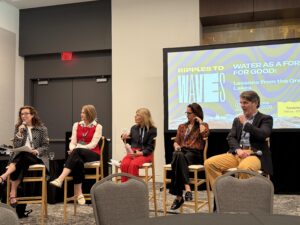
I had the privilege of moderating a panel — Water As A Force For Good — that connected innovation, investment, and advocacy around one of our most essential shared resources: water. Our discussion centered on two sets of levers used by individuals, businesses, and policymakers to make the world a better place: the handprint and footprint of business, and the intersection of market dynamism and policy dynamism.
Riverwater’s Responsible Investing framework considers both the operational footprint and the societal impact handprint of every business we evaluate.
A company’s footprint is how it operates — the water it uses, the energy it consumes, the way it treats its people and its suppliers. A company’s handprint is what it puts into the world — whether its products or services, at scale, bring real solutions to the world’s problems. Both matter.
Why Operational Footprint Discipline Looks Like Good Management
Amy Taylor, CEO of Zevia, described a cost-reduction exercise she led across her business. She didn’t frame it as a sustainability initiative. She framed it as a book-to-book cost-out, the kind any CFO would recognize, and her CFO led. Then she added two columns to the reporting: water use impact and fuel efficiency impact. Every cost-saving idea had to be reported in three columns instead of one.
 Eighteen months later, Zevia had taken $15 million in cost out of a $170 million business. The operational improvements that drove the savings — co-manufacturer selection, and warehouse locations and thus freight routing — also reduced water and fuel consumption.1
Amy’s insight was practical. Had she asked her finance team to pursue sustainability targets first, she may have gotten polite resistance. By asking them to pursue cost targets with sustainability as a second lens, she got both. The cost-out list and the sustainability list turned out to be the same list.
This is what good footprint management looks like from inside a company. Not a separate initiative. Two more columns on the same spreadsheet.
Karen Frost of The Water Council shared a story that should resonate with all business operators. A WAVE assessment — the Water Council’s independently verified water stewardship program — flagged one of a corporate client’s manufacturing sites as an outlier in water consumption. When the team investigated, they discovered the supplier delivering water to the plant was diverting part of it to another customer while charging the first company for the full volume.2
One location’s outlier consumption was the red flag. That’s what auditing your own footprint can uncover — the kind of operational insight that would have been invisible without the discipline of digging deep.
The Handprint: How a Company’s Products Create Real-World Value
Karen Frost also runs the Water Council’s BREW 2.0 post-accelerator program in Milwaukee. She works with a global portfolio of companies commercializing technology for PFAS capture, microplastic filtration, E. coli detection, watershed analytics, and more. Water technology takes a long time to reach the market — often ten to fifteen years from prototype to adoption — and the Water Council works specifically with companies that are ready to scale. The innovation these companies bring (their handprint) solves real problems.
Likewise, Amy described Zevia’s vision for its beverages to promote health, affordability, and clean environments — their clean-label, zero sugar soda is literally a force for good.
These are companies whose entire reason for existing is to solve a problem. We call this the handprint. The B Corp community calls it using business as a force for good.
How Voluntary Corporate Action Creates Space for Better Policy
Joel Brammeier, president of the Alliance for the Great Lakes, walked through a case where business innovation (market dynamism) led to stronger policy initiatives to protect the environment (policy dynamism). In 2013, Scotts Miracle-Gro voluntarily removed phosphorus from its residential lawn fertilizer line.3 The science showed residential lawns didn’t need the phosphorus, so Scotts saved money on inputs, earned goodwill with consumers, and — Joel’s point — earned a seat at the policy-making table in Ohio.
Ohio has a long-standing challenge with toxic algae blooms in Lake Erie, driven by phosphorus runoff. Once Scotts had acted, the conversation shifted toward where the phosphorus was actually coming from, which is large-scale agriculture, allowing attention to turn to solving the greater problem.
Voluntary corporate action doesn’t replace regulation. It changes what the regulatory conversation can address. Companies that act before they’re made to act often find themselves shaping the rules they’ll eventually have to live with — an outcome that is strategic, not only virtuous.
Why Footprint and Handprint Matter for Responsible Investors
At Riverwater, our Responsible Investing process considers both footprint and handprint when we evaluate a company.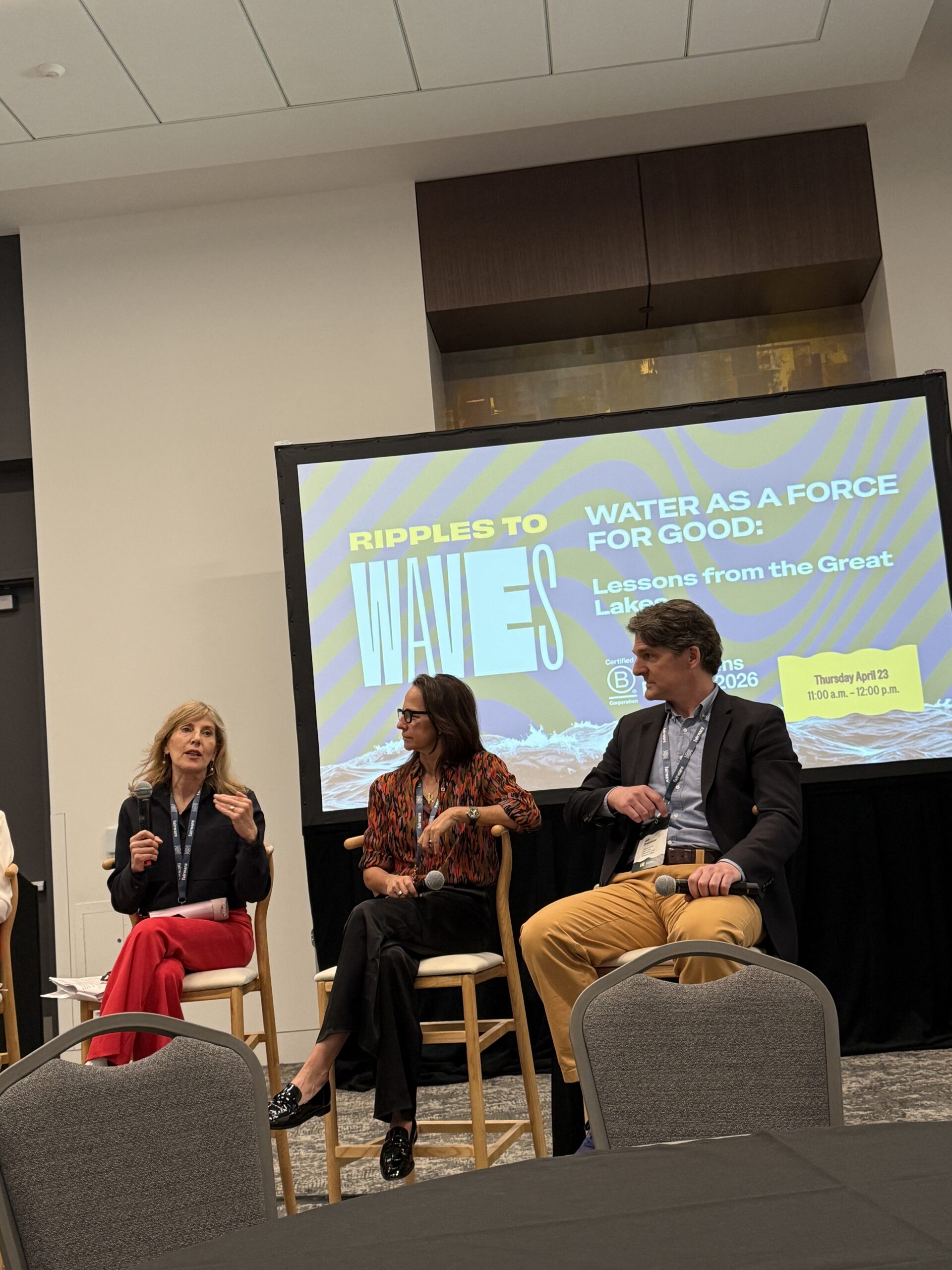
Footprint and handprint aren’t separate from business fundamentals. They are a clear window into whether a management team understands its operations and the solutions its products or services bring to society. They absolutely impact the likelihood that the company will be resilient and prosperous in the face of our changing world. We document this work each year in our Sustainability Report, which quantifies the footprint and handprint metrics across our portfolio companies.
Amy Taylor’s two columns revealed a management team that knew how to align cost discipline and environmental discipline. Karen Frost’s WAVE story revealed what happens when a company audits itself rigorously enough to find inefficiencies others miss. Joel Brammeier’s Scotts example revealed how early action creates strategic room that late action cannot.
These are stories about how companies using business as a force for good bring prosperity for all. Wisconsin State Senator Jodi Habush Sinykin closed her portion of the panel with an invitation: bring policymakers into your business. Show them how your work connects to the outcomes they are trying to shape. I extend that invitation to the investment community as well. The companies we own, and the companies we consider owning, have stories like these to tell. It is worth our time to ask.
Citations
Cindy Bohlen, CFA, is Director of Responsible Investing & Chief Mindfulness Officer at Riverwater Partners, which manages strategies for institutions and individuals with a focus on responsible value creation and small-cap stocks.