What our Favorite Characters Teach Us About Money
A client once told me that the hardest part of investing wasn’t the initial investment — it was sitting still when everything in him wanted to do something at different points in time. I’ve thought about that a lot since. Because the truth is, most of the mistakes I see people make with their money don’t come from a lack of information. They come from being human.
Money is emotional. We like to think of investing in terms of the best times we have been invested and hope that repeats itself over and over, but as the saying goes, “past performance isn’t indicative of future results.” The numbers aren’t the problem — the problem is how we feel when we look at them. Everybody’s experience with investing is unique. But when markets drop, what makes us feel the way we do?
I remember reading a line early in my career that helped me separate my investing goals from everything else: “Investment performance is not a financial plan.” Read that again. Investing on its own does not make a plan, especially over a long horizon. It usually starts when we are new to the idea of parting with our savings or cash flow in hopes of seeing our money grow.
For example, when I made my first 401k contribution back in 2001, it frightened me, so I started small. I was too young and inexperienced to realize that $25 or $50 a paycheck wasn’t going to send my personal finances into a tailspin. But I had just moved to a new city, was paying high rent relative to my income and was scared I wouldn’t have much money left over. Simply put, my brain couldn’t yet connect the long-term idea of investing for my future while my immediate focus was paying next month’s rent.Luckily for me, a more experienced co-worker kept bugging me about it, and I finally relented — and am still thankful he did. I even saved that old 401(k) statement (still have it to this day) from when the balance was virtually nothing, just to memorialize where I started.
So I try to help our clients in two ways: first, separate the short-term day-to-day financial planning from long-term investing goals; second, understand the explicit purpose behind those goals and create a strategy to accomplish them. Cognitive conflict generally occurs when the purpose and strategy don’t align, and it can trigger an emotional reaction — which is only natural. Investing in your hard-earned resources is a serious matter and deserves a thoughtful, ongoing discussion. Like financial planning itself, investing is not a one-time event, and the strategy should be reviewed regularly.
Over the next few weeks, we’re having a little fun on LinkedIn by pairing some of the most familiar characters from television with the behavioral biases that quietly shape our financial decisions. The characters are exaggerated, of course. That’s what makes them stick. But the patterns underneath are very real.
And I’d bet you recognize a few of them in yourself or someone you know. I know I do.
Regret Aversion: Why Fear of a Wrong Call Freezes Investors
If you remember George Costanza from Seinfeld, you know he was so paralyzed by the fear of making the wrong call that he eventually decided to do the exact opposite of every instinct he had.
It’s played for laughs, but regret aversion is one of the quieter, more destructive biases I see in financial planning. The fear of looking back and wishing we’d done something different can freeze us completely, or worse, push us into a panic-driven decision we never really wanted to make.
Should I sell now?
Should I wait?
Should I move to cash?
What if I’m wrong?
That “what if” can get incredibly loud. When you are deeply afraid of future regret, the kindest and smartest thing you can do is give yourself room to slow down, think, and look at the big picture rather than simply reacting to events.
Loss Aversion: The Hidden Cost of Sitting in Cash
Here’s something I’ve learned over time: avoiding pain in the moment almost always feels better than pursuing a gain down the road.
That’s loss aversion, and it’s one of the most powerful forces in investing. Studies suggest the sting of losing actually feels roughly twice as strong as the pleasure of gaining the exact same amount.1
I think about a gentleman who came to us after sitting entirely in cash since 2022. He wasn’t uninformed — he simply couldn’t stand the idea of watching his account drop again, so he stayed on the sidelines and missed the subsequent market recovery. The fear was real, but the decision it led to was incredibly costly, and he was emotionally stuck.
When markets get loud, following your plan can feel wrong — a little like ignoring a fire alarm when you’ve been told it’s only a test. But that’s usually the exact moment the plan matters most.
Herd Mentality: Lessons from the GameStop Frenzy
Of course, fear of loss has a flip side, and Seinfeld gave us a character for that one too. Cosmo Kramer never met a scheme he didn’t chase — bursting through the door, fully committed to whatever idea had grabbed him five minutes earlier. That’s herd mentality, better known these days as FOMO: the fear of missing out.
Remember the GameStop frenzy in January 2021? The excitement was its own kind of pressure. To put that volatility in perspective, the stock started the month around $4.30 a share (split-adjusted). By January 28, it exploded to an all-time high around $120 a share before plummeting roughly 80% from that peak within a single week.2
 The people who got hurt weren’t usually the ones who’d been there early. They were the ones who, watching it climb, felt they couldn’t stand to miss out and bought in late. A study analyzing retail brokerage data during the frenzy found that nearly 96% of all retail trades in GameStop occurred after the stock had already skyrocketed. It wasn’t a calculated financial strategy; it was pure, unfiltered FOMO. Unsurprisingly, the same researchers found that the median investor who bought in during that peak window lost around 13% of their money in a flash.3
When everyone around you seems to be getting rich, sitting still feels like losing. It isn’t. It’s usually the plan working.
Overconfidence Bias: Why You Can’t Time the Market
If you remember Cliff Clavin from Cheers, you know the type. Endlessly certain, full of facts, and almost always wrong.
We laugh because we’ve all met a Cliff. What’s harder to admit is that, when it comes to money, a little bit of Cliff lives in most of us. Overconfidence convinces us we can time the market perfectly, pick the single winning stock, or spot a macro trend before everyone else.
Generally speaking, the people I worry about least are the ones who are comfortable saying, “I’m not sure.” Confidence isn’t the enemy. Unchecked confidence is — the kind that stops asking questions and turns a hunch into a certainty. A good financial plan has humility built right into it.
Confirmation Bias: When Research Is Really Just Reassurance
J.R. Ewing from Dallas never met a piece of information he couldn’t bend to fit what he already wanted to believe.
That’s confirmation bias, and it’s incredibly sneaky. We naturally seek out the news that agrees with our current worldview and quietly tune out the rest. It feels like research, but it’s really just reassurance.
I’d say one of the most useful things an advisor can do is gently offer the other side of the coin. Not to argue, but to make sure you’re looking at the whole picture before you pull the trigger on a major financial decision. Let me be your sounding board for the view you didn’t go looking for.
What These Characters Are Really Telling Us
Here’s what I keep coming back to: none of these biases mean something is wrong with us. They mean we’re human, and our brain is doing exactly what brains are wired to do.
But the cost of all that very human behavior is measurable. The research firm DALBAR has studied how real investors behave for more than thirty years, and its findings are remarkably consistent: the average investor tends to earn less than the very funds they own, simply because of when they choose to buy and sell. Over the twenty years through 2024, DALBAR found the average equity fund investor earned about 9.2% annually, while the S&P 500 returned 10.4% — an annual shortfall of roughly 1.2%..4
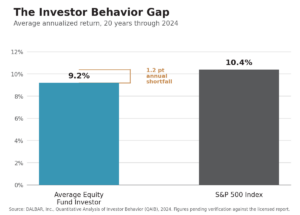 That gap of roughly a percentage point a year doesn’t sound like much, but compounded over decades, it’s the difference between the retirement you planned for and a meaningfully smaller version of it. The shortfall wasn’t the market’s doing. It was behavior.
The goal isn’t to eliminate emotion from investing, because you can’t, and frankly, you wouldn’t want to. The goal is to build a plan thoughtful enough that your emotions don’t have to make the final decisions.
Investing alone isn’t a financial plan. A plan is what holds steady when fear is high and certainty is louder than it should be. So the next time you catch a little Cliff, J.R., Kramer, or George creeping into your thinking, I hope you smile — and then pick up the phone. That’s exactly what we’re here for.
Summary of Behavioral Biases
| Character (Show) | Behavioral Bias | The Financial Trap |
|---|---|---|
| George Costanza (Seinfeld) | Regret Aversion | Freezing up or acting against instincts to avoid future remorse. |
| The Investor in Cash | Loss Aversion | Exiting (or never entering) the market because the pain of a drop outweighs the promise of a gain. |
| Cosmo Kramer (Seinfeld) | Herd Mentality / FOMO | Chasing whatever is climbing because everyone else seems to be winning. |
| Cliff Clavin (Cheers) | Overconfidence | Thinking you can predict the unpredictable or time the market. |
| J.R. Ewing (Dallas) | Confirmation Bias | Only seeking data that validates what you already want to believe. |
Citations
The information provided herein reflects the opinions of Riverwater Partners, LLC as of the date of publication and is subject to change without notice. It is provided for informational and educational purposes only and should not be construed as investment advice or a recommendation to buy or sell any security. Past performance is not indicative of future results. Investing involves risk, including the potential loss of principal. Indices cannot be invested in directly and are unmanaged. The client scenarios described herein are illustrative, and identifying details have been altered to protect client privacy. Riverwater Partners does not guarantee the accuracy or completeness of this information and is not responsible for any errors or omissions. Clients or prospective clients should consult their financial advisor before making any investment decisions. Riverwater Partners is a Registered Investment Advisor with the U.S. Securities and Exchange Commission (SEC).