
Q1 2026 Small Cap Macro Update: The Fog of Excursion
Thirty Smelters to Four
In 1980, the United States operated roughly thirty primary aluminum smelters. Today there are four. The country that once produced nearly a third of the world’s aluminum now accounts for less than two percent of global output. Production peaked at 4.6 million metric tons in 1980. By 2024, it had fallen to around 650,000 tons.
This didn’t happen overnight. It happened slowly, over decades, as rising electricity costs, cheaper foreign capacity, and the steady pull of globalization hollowed out an industry most people stopped thinking about. Smelters closed in Washington, Missouri, Kentucky, and Texas. The workforce shrank. The expertise left. And for a long time, it didn’t seem to matter much. Aluminum kept showing up.
On February 28, it started to matter.
The Excursion
That was the day the United States and Israel launched airstrikes across Iran, killing Supreme Leader Khamenei and triggering the most significant disruption to global energy and commodity flows in decades. Iran retaliated with missile and drone attacks on Israel, US military bases, and allied Gulf States. The Islamic Revolutionary Guard Corps (IRGC) closed the Strait of Hormuz to commercial traffic. Roughly twenty percent of the world’s oil and natural gas, and nine percent of its primary aluminum, stopped moving. The administration called it an excursion.
March saw significant swings in oil prices. Dubai crude (a medium sour benchmark typically used for pricing oil sold into Asia) hit $166 in mid-March, a significant premium to global benchmarks. This high price illustrates the real-time demand from Asian buyers who may be willing to pay above-market price (Brent oil pricing) for access to crude oil. Brent oil also spiked, hitting above $114 before falling to $94 on a ceasefire announcement (only to climb again when the ceasefire produced no actual reopening of the Strait). Oil swung 17–19% intraday on March 7 amid false rumors about naval escorts. Two hundred and thirty loaded tankers sat idle inside the Persian Gulf. The fog was everywhere.
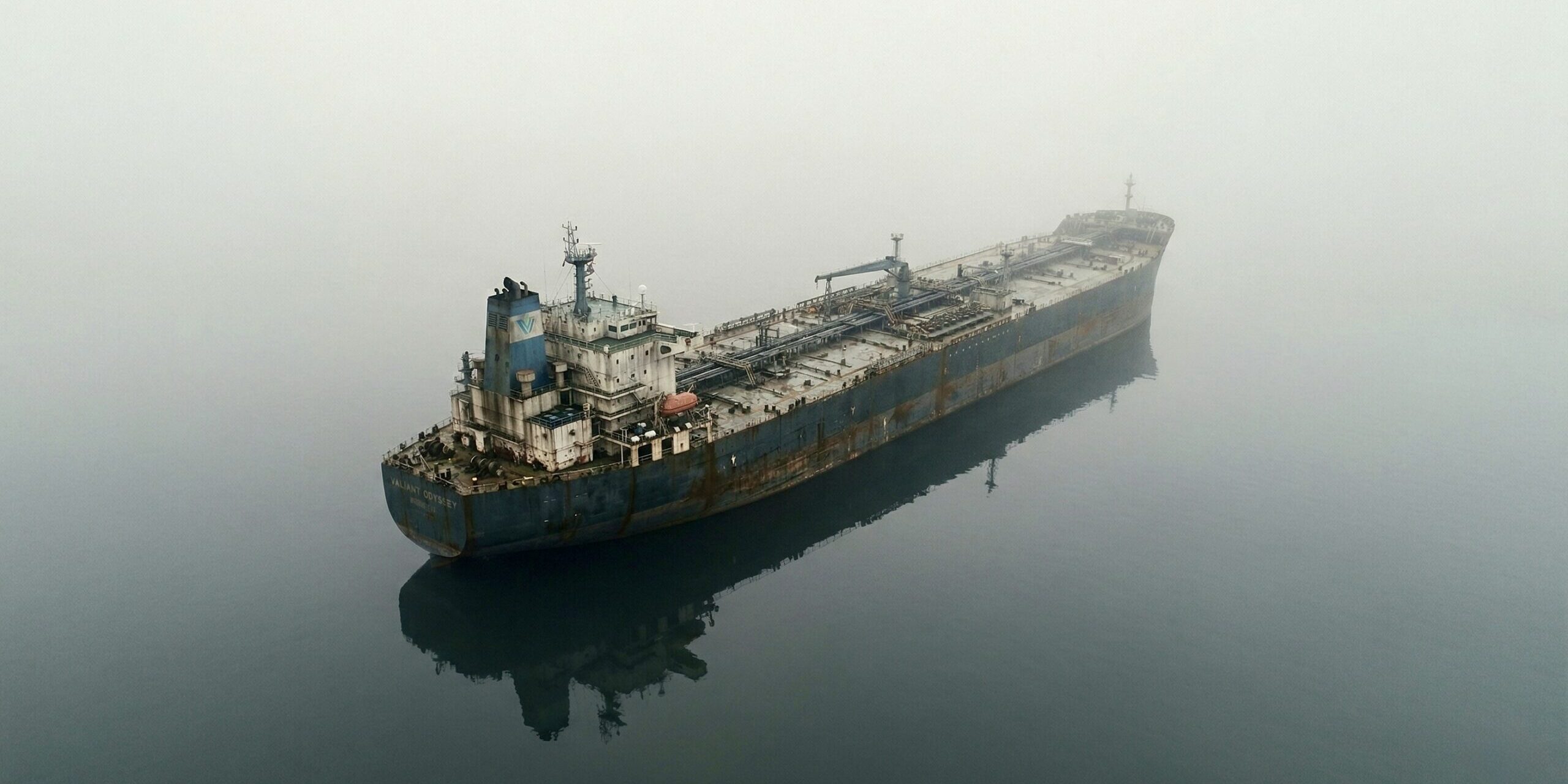
As we write this letter, the fog has thickened, not cleared. Peace talks in Islamabad between Vice President Vance and Iranian officials collapsed on April 12 without agreement. The President has declared a full naval blockade of the Strait of Hormuz beginning April 13, while Iran’s IRGC has warned that any military vessels approaching the Strait will be met with force. This is not the language of resolution.
OVX Index — 10 Year History
CBOE Crude Oil ETF Volatility Index (monthly closes, Jan 2016 – Apr 2026)
Why Aluminum Tells the Story
We use aluminum because it illustrates something broader about how this conflict reshapes fundamentals—not temporarily, but structurally.
The Middle East supplies approximately nine percent of the world’s primary aluminum. The UAE and Bahrain are home to some of the largest smelters on earth, powered by cheap natural gas and built over decades to serve global manufacturing. When the Strait closed, that supply didn’t just slow down. It stopped. LME aluminum prices surged past $3,500 per ton. Regional premiums in the US Midwest and Europe hit records as industrial buyers scrambled to secure metal.
Then it got worse. On March 28, strikes damaged Emirates Global Aluminium’s Al Taweelah power plant and Aluminium Bahrain’s facilities. In aluminum smelting, a power failure is catastrophic: molten metal solidifies inside the cells, a process called “freezing.” Repairing frozen potlines can take a year or more and requires massive capital expenditure. Alba declared force majeure on all shipments. These are not disruptions that resolve with a ceasefire.
Meanwhile, the United States, with its four remaining smelters operating well below capacity, suddenly found its domestic aluminum production to be a strategic asset of national importance. Facilities that were marginal in a world of cheap global supply became essential overnight. Capacity restarts accelerated. A $500 million Department of Energy grant for a new green smelter took on new urgency. The logic of reshoring, energy security, and supply chain resilience went from theoretical to immediate.
This is the pattern we see repeating across industries—not just aluminum, but fertilizers, methanol, refined products, and industrial gases. The war did not create these supply vulnerabilities. Decades of offshoring and underinvestment did. The war made them urgent. And the fundamental improvements now underway—capacity restarts, reshoring investment, import substitution—do not reverse when the conflict ends. They accelerate.
Quality Reasserts Itself
For the better part of last year, the market rewarded speculation over fundamentals. Loss-making companies outperformed profitable ones. Stocks with stories beat stocks with earnings. We have written about this dynamic in previous letters, and we have been candid about the cost of staying disciplined through it.
The first quarter of 2026 began to change that. The Russell 2000 Value Index gained 5.0% for the quarter versus a loss of 2.8% for Growth. That’s a nearly 800 basis point spread. Energy, Materials, and Industrials led the way. The sectors that produce real goods, generate real cash flow, and benefit from tangible supply-demand dynamics outperformed decisively, particularly in the second half of the quarter as the geopolitical premium took hold.
We are not declaring victory. One quarter does not make a cycle. But the shift is consistent with what has historically followed periods of speculative excess: the market begins to reprice quality, profitability, and balance sheet strength—slowly at first, then unmistakably. We believe we are in the early innings of that repricing.
Performance and Positioning
Our results in Q1 were mixed. The Sustainable Value Strategy underperformed its benchmark for the quarter. The Small Cap Core Strategy outperformed. In both cases, the outcome was less about stock selection failures or successes and more about timing. We spent much of the quarter repositioning, adding exposure to industries where we believe the conflict is structurally improving fundamentals, and many of those positions were initiated late enough in the quarter that they did not yet contribute meaningfully to returns.
We are comfortable with that tradeoff. The question we are answering is not “what worked last quarter?” but “what will work over the next several years?” And we believe the answer is concentrated in a handful of themes: domestic commodity production with structural supply advantages, critical materials and reshoring beneficiaries, energy infrastructure and downstream processing, and agricultural inputs where global supply chains have been disrupted.
These are not trades. They are not bets on the duration of the war. They are investments in companies where the fundamental outlook has materially improved, where demand is rising, supply is constrained, pricing power is real, and the competitive position is strengthening regardless of what happens in the Strait of Hormuz next month.
On the Fog
Carl von Clausewitz, the Prussian military theorist, warned that war is the province of uncertainty. He was writing about battlefields when he coined the term “Fog of War.” He could have been writing about this market.
The information environment is unreliable. Officials contradict each other within hours. Ceasefire announcements produce no ceasefires. A naval blockade is declared on a Sunday afternoon. Oil moves double digits on headlines that are retracted by evening.
We do not pretend to know how this ends. We do not know when the Strait reopens, or whether the damaged smelters in the Gulf will be rebuilt, or what the second-order effects on European manufacturing or Asian supply chains will ultimately be. Nobody does. That is the fog.
What we do know is our framework. We own companies with strong management teams, durable competitive advantages, and attractive valuations. We own companies that produce things the world needs, in places the world can access. We have been building and managing these portfolios for years, and the events of the last six weeks have reinforced rather than undermined our conviction in them.
The fog will persist as long as there is no lasting peace. As of today, that peace is not close. But we have been here before—not in this specific conflict, but in this feeling of uncertainty. And what we have learned, across more than twenty-five years in the markets, is that we are comfortable with the companies we own in times of fog because we believe they have good visibility, solid balance sheets and good management teams.
As always, thank you for your trust and partnership. Please reach out with any questions.
Adam Peck, CFA
Co-Founder & Chief Investment Officer
Riverwater Partners LLC
Related Reading
- Q4 2025 Small Cap Year-End Letter: The Four-Year Harvest — Our year-end letter discussing quality investing, patient capital, and the setup for 2026.
- Why Quality Underperformed in 2025 — And Why History Suggests a Reversal — The analytical case for the quality factor inflection underway.
The opinions expressed herein are those of Riverwater Partners and are subject to change without notice. This material is not financial advice or an offer to sell any product. Forward-looking statements are not guaranteed. Riverwater Partners is a registered investment adviser. Registration does not imply a certain level of skill or training. More information about Riverwater Partners, including fees and objectives, can be found in our ADV Part 2, which is available upon request. Past performance is not indicative of future results. Investments are subject to risk, including the loss of principal. The Russell 2000 Value Index measures the performance of the small-cap value segment of the US equity universe and is not available for direct investment. Reader should not assume that investments in the securities or themes identified were or will be profitable. The holdings identified do not represent all the securities purchased, sold, or recommended. The calculation’s methodology along with details on all holding’s contribution to the overall account’s performance during the measurement period are available upon request.